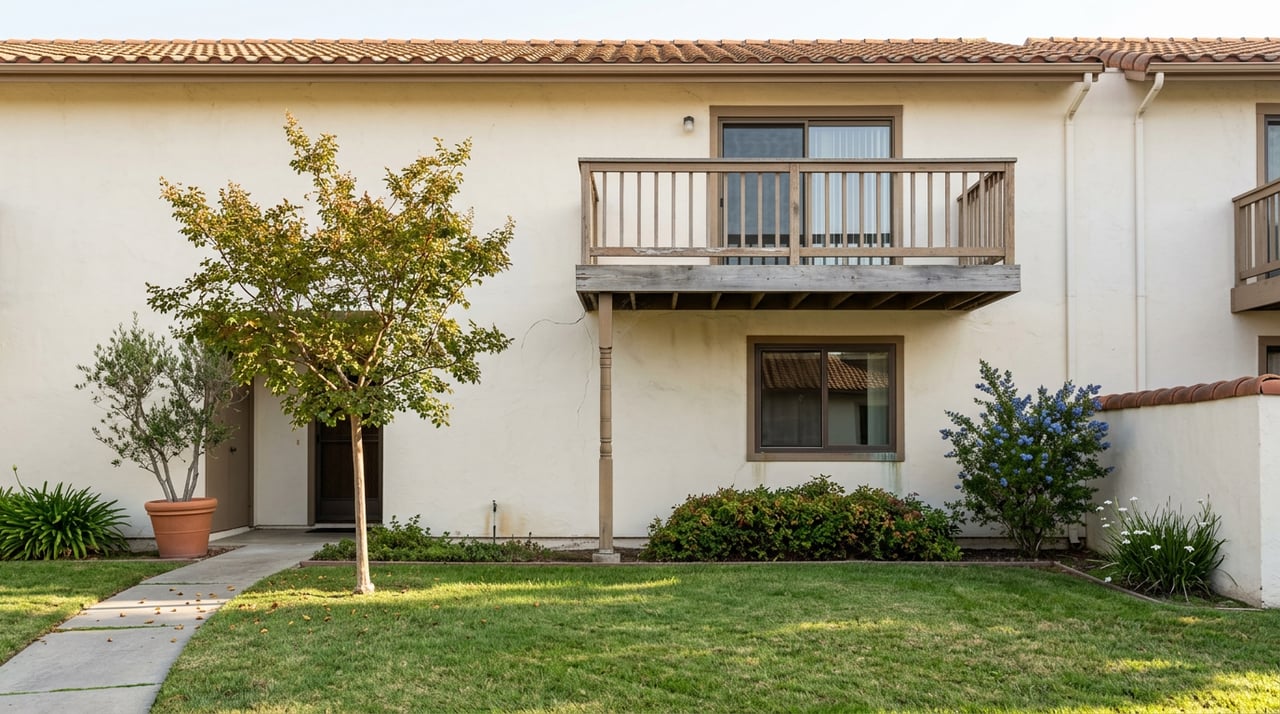
A legal deadline for California condominium associations came and went on January 1, 2025. Most homeowners inside those associations never heard about it. Many board members assumed they had another year, because a different but similarly named law did get pushed back. It did not apply to them.
That mix-up is not just a compliance footnote anymore. As of this January, a second law folded the results of that inspection directly into the paperwork buyers see during escrow. For anyone selling or buying inside one of Camarillo's older HOA-governed condo and townhome complexes, this is no longer a future concern to research eventually. It is a question that should get answered before a listing goes live or an offer gets written.
The Two Laws Everyone Mixes Up
California passed two related laws after a balcony collapsed at an apartment complex in Berkeley in 2015, killing six people. Both require inspections of exterior elevated elements, meaning balconies, decks, stairways, and walkways built with wood framing and elevated more than six feet off the ground. Both were a direct response to that tragedy. From there, the two laws split.
| SB 721 | SB 326 | |
|---|---|---|
| Covers | Rental apartment buildings | Condominium associations (common interest developments) |
| Codified as | Health & Safety Code §17973 | Civil Code §5551 |
| First deadline | January 1, 2026 (extended from 2025 by AB 2579) | January 1, 2025 (no extension) |
| Re-inspection cycle | Every 6 years | Every 9 years |
| Who orders it | Property owner or landlord | HOA board of directors |
The apartment deadline got a one-year reprieve. The condo deadline did not. That single difference is where the confusion started, and it is why so many HOA boards walked into 2025 thinking they had breathing room they never actually had.
Why the Deadline Already Passed and No One Extended It
Civil Code §5551 required every California condominium association with three or more units and qualifying wood-framed balconies, decks, or walkways to complete its first structural inspection by January 1, 2025. A licensed structural engineer or architect had to do the work, examine a statistically significant sample of the elements, and file a written report with the board.
That deadline is now more than a year and a half behind us. Boards that missed it are not in a grace period. They are already out of compliance, and the law does not require anyone to notify homeowners when that happens.
An October 2025 industry report on the law estimated that more than a fifth of California condo associations had already missed the January 2025 deadline, and noted that most cities and counties across Southern California offer little public guidance to homeowners trying to figure out whether their own association is one of them. That gap between what the law requires and what most owners actually know is the whole problem in miniature.
What This Looks Like Inside an Older Camarillo Complex
Camarillo's housing stock includes a meaningful share of townhome and condo developments built in the 1970s and 1980s, long before anyone drafting a purchase agreement thought about wood rot as a legal liability. Del Prado Townhomes is a good example of the type. The complex was built in the 1970s on 12.9 continuous acres in central Camarillo, with 169 homes ranging from single-story to two-story layouts, each with its own front and rear private outdoor space. Public business records classify the governing body as a condominium association, the exact ownership structure Civil Code §5551 was written to reach.
That is not a claim about whether any specific community has completed its inspection or not. It is a description of the kind of property where the question is worth asking in the first place. A complex with decades-old wood-framed decks, private patios built into a common-ownership structure, and an HOA board that has been managing routine maintenance since before this law existed is exactly the profile SB 326 targets. Camarillo has more than one of these. Whether a given board acted on it is a fact you have to go find, not one you can assume from the age of the buildings.
What a Missed Deadline Turns Into at the Closing Table
Two things changed the stakes here in the last twelve months.
First, insurance carriers have started treating SB 326 compliance as an underwriting question. Master policies for condo associations increasingly require proof of a completed inspection before renewal, and boards without that paperwork are seeing higher premiums or outright non-renewal.
Second, Senate Bill 410 took effect January 1, 2026 and pulled the inspection report into the reserve study disclosures every HOA must provide to prospective buyers. That means a seller in a Camarillo condo or townhome community can no longer treat this as background noise. If the inspection happened, the report is part of what a buyer's agent will ask for. If it did not happen, that absence is its own disclosure.
Industry reporting on the law has documented special assessments ranging from roughly $10,000 to $25,000 per balcony for standard repairs, with full structural reconstruction running $40,000 to $60,000 per unit in higher-cost markets, and one HOA attorney reporting assessments as high as $175,000 per unit in the worst cases he has seen.
Those numbers do not describe every association, and they should not be read as a prediction for any specific Camarillo complex. They describe what happens when a deferred maintenance problem meets a mandatory inspection all at once, which is precisely the scenario a missed 2025 deadline sets up.
Before You List: A Seller's Checklist
- Ask your HOA board or property manager, in writing, whether the SB 326 inspection was completed and when.
- Request the actual inspection report, not just a summary. Under SB 410, this should already be part of what the association discloses.
- Confirm whether the reserve study has been updated to reflect the inspection's findings. If the study predates the report, it is legally incomplete.
- Ask directly about any pending or anticipated special assessments tied to exterior elevated elements.
- If the inspection has not happened, find out why, and get a timeline before you set a list date.
Before You Write an Offer: What Buyers Should Ask
- Is this property legally a condominium or a planned development? SB 326 only applies to true condominiums where the structure is owned in common. A townhome where you own the walls and roof outright falls outside the law entirely.
- Has the HOA completed its SB 326 inspection, and can you see the report before your contingency period ends?
- Does the current reserve study reflect the inspection's findings, or predate it?
- Has the association's insurance carrier requested proof of compliance, and did the HOA provide it?
- Are there any special assessments already approved or under board discussion related to balconies, decks, or walkways?
FAQ
Does SB 326 apply to every townhome in Camarillo? No. The law applies only to true condominiums, where the exterior structure is owned in common by the association. If your townhome is legally a planned development and you own the structure and lot outright, SB 326 does not apply, though your CC&Rs may still require you to maintain your own deck or balcony.
What if my HOA never completed the inspection? The association is currently out of compliance with state law. That does not mean a sale cannot happen, but it does mean there is no engineer's report to review, no updated reserve study reflecting structural condition, and a real chance the issue surfaces later as an unbudgeted special assessment or an insurance problem for the whole community.
Does this affect single-family detached homes in Camarillo? No. SB 326 is specific to condominium associations with buildings of three or more units. A detached single-family home, even one inside an HOA, is not covered by this particular law.
How often does the inspection need to happen after the first one? Every nine years, assuming the association met its first deadline. Associations that completed their inspection on time in early 2025 will not need to repeat it until 2034.
If you own in one of Camarillo's older condo or townhome communities and you are not sure where your HOA stands on this, that is worth resolving before you list, not after an offer is already on the table. And if you are looking to buy into one of these communities, the report you ask for during your contingency period could save you from inheriting a problem the current owner never had to disclose until this year.
Rick Pena has spent 24 years working Camarillo real estate from both sides of escrow, with a background in title and escrow that started at First American Title. If you want a second set of eyes on an HOA's paperwork before you list or before you write an offer, Let's Connect.