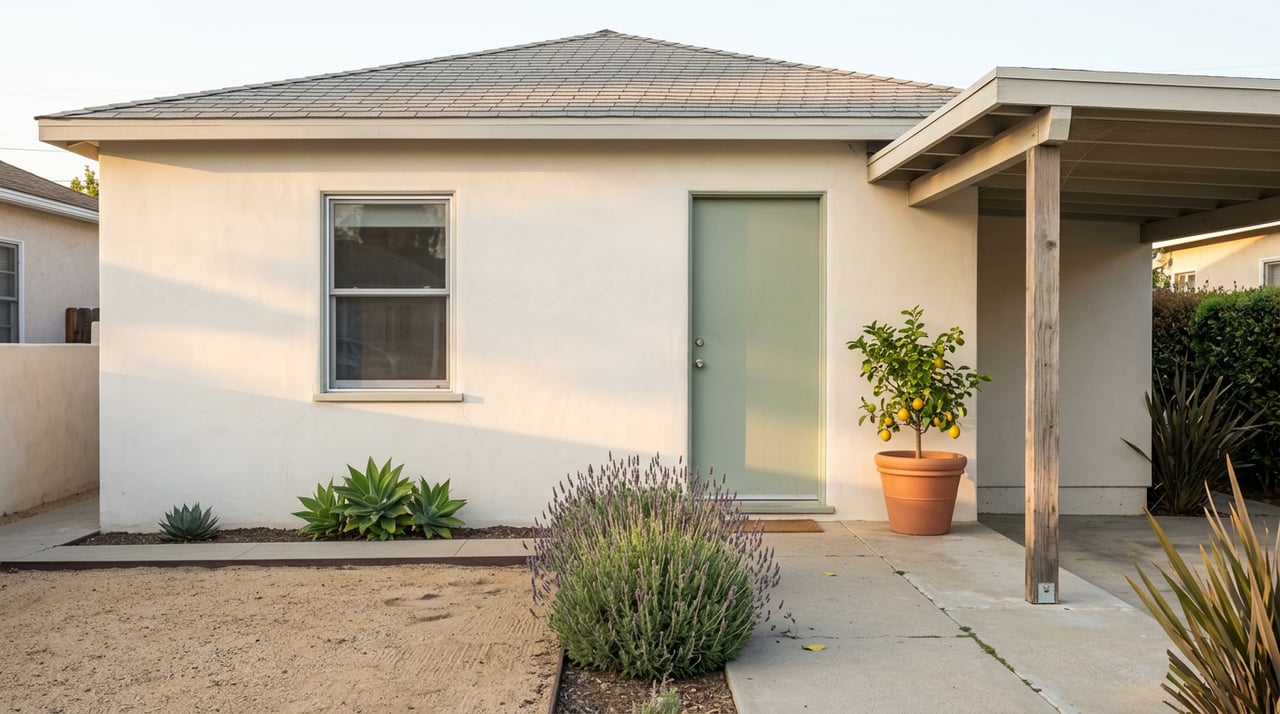
Jordan Blank's home at Camarillo Mobile Home Estates sat listed for almost 75 days this spring. People walked through, liked the layout, then asked the same question before they got to the kitchen: what's the space rent. When Blank told them $2,060 a month, the visit usually ended there.
"Everyone that comes says, 'Rent is $2,060 a month, how can we afford that?'" Blank told the Camarillo City Council during public comment this spring. "They love the house, but nobody will touch it."
That sentence is the whole story of Camarillo's mobile home market right now, and it's the reason the city just passed its first permanent rent stabilization ordinance for the three parks inside city limits. But the new law doesn't simply cap rent increases and move on. It draws a line that most buyers won't think to ask about until they're already in escrow, and that line runs through the mobile home itself, not through the person buying it.
The Sign Out Front Was Never the Real Price
Camarillo has three mobile home parks: Camarillo Mobile Home Estates, Lamplighter Mobile Home Park, and Casa Del Norte Mobile Home Park. For years, homes inside them carried some of the lowest asking prices in Ventura County. That sounds like an entry point for buyers priced out of everything else in Camarillo. In practice, it became a trap.
By April 2026, city data showed average monthly land rent across Camarillo's mobile home parks had climbed above $2,000, according to reporting in the Camarillo Acorn. A separate county comparison the same month, reported by the Ventura County Star, found move-in rent at Camarillo's three parks averaging $1,870, against $829 at parks elsewhere in the county already under rent stabilization. The same reporting noted that Camarillo and Lamplighter also contained the mobile homes with the lowest asking prices anywhere in the county.
Put those two facts together and you get Blank's living room. A low asking price looks like an opportunity until a buyer runs the real monthly math and realizes the land under the house can cost more each month than the mortgage on it would. Residents told the council they couldn't sell because rent increases had quietly eroded the resale value of homes that, on paper, looked affordable.
The city had already tried a stopgap. In October 2025, the council adopted a six-month moratorium capping increases at 4.2 percent while staff drafted something permanent. That temporary fix was set to expire April 20, 2026, which is why the spring council meetings carried real urgency.
What Changed on May 22
The council rejected an early draft 3-2 on March 25, 2026, sending it back for revision over one specific disagreement: how much a park owner could raise rent the moment a space changed hands. On April 22, 2026, the council unanimously adopted a permanent ordinance. It took effect May 22, 2026, just under three months ago, at all three parks.
For a tenant staying put, the rule is straightforward: annual increases are capped between 2 and 6 percent, tied to the Consumer Price Index. Increases above that band require a park owner to show the money is going toward capital improvements or rising operating costs, and residents can petition for review.
That part isn't the interesting part. The interesting part is what happens at the moment of sale, because that's the moment that actually decides whether a home like Blank's finds a buyer.
The Fine Print That Still Catches Buyers Off Guard
Under the adopted ordinance, a rent reset doesn't hinge on whether the resident is new. It hinges on whether the mobile home is new.
| Scenario | What happens to space rent |
|---|---|
| Current resident keeps their existing home | Capped at 2-6%, tied to CPI |
| Space re-rented to a new buyer who keeps the existing mobile home in place | Capped at 8% at the point of re-rental |
| Space re-rented to a new buyer who brings in a new manufactured home | Park owner may reset to market rate |
| Current resident swaps their home for a new manufactured home | Park owner may reset to market rate |
That distinction matters more than the headline cap. It means the protection travels with the physical structure sitting on the lot, not with whoever's name is on the deed. Buy an older home and leave it exactly as it is, and the worst a park owner can do at transfer is an 8 percent bump. Buy the same lot and bring in a newer manufactured home, or ask the seller to upgrade before closing, and the rent can jump straight to whatever the market will bear.
Two homes on adjacent lots, same square footage, same view, can carry completely different rent trajectories for the rest of their ownership depending on whether either one has ever been swapped for a newer unit. That's not something a listing sheet tells you.
What This Means If You're Buying Into One of the Three Parks
Before writing an offer at Camarillo Mobile Home Estates, Lamplighter, or Casa Del Norte, it's worth asking the seller or park management for a few specific things:
- The current space rent for that exact lot, in writing, not an average for the park
- Whether the mobile home currently on the lot is the original unit or a replacement, and when that replacement happened
- Whether the seller has any plans, or has been asked by the park, to swap the unit before close
- The park's most recent rent increase notice, so you can see whether it falls inside the CPI-tied cap or was tied to a re-rental event
Camarillo Mobile Home Estates is an age-restricted 55-and-over community. Lamplighter is open to all ages. That distinction matters for who can live there, but it has no bearing on which rent-reset scenario applies. That's determined entirely by the unit, not the resident.
What This Means If You're Selling
The ordinance doesn't make the rent number disappear. It just makes the ceiling predictable, which is a different thing than making the number small. A buyer looking at a home in one of these three parks still needs to see the real monthly cost laid out plainly, ideally before they're standing in the kitchen doing math in their head the way Blank's visitors clearly were.
Sellers who get ahead of that conversation, by disclosing current rent, the unit's replacement history, and where the home falls on the table above, are giving a buyer the information to actually finish the tour instead of walking out at the first mention of the number.
Camarillo was late to this compared to some of its neighbors. Thousand Oaks adopted its own mobile home rent stabilization ordinance back in 1980, and under that program rent increases for the period running November 1, 2025 through October 31, 2026 are capped at 3 percent, according to the Golden State Manufactured-Home Owners League. Camarillo's three parks operated for decades without that kind of ceiling, which is a big part of why the gap between local rents and the countywide rent-stabilized average grew as wide as it did before the council acted this spring. Camarillo's new rules are adopted as Chapter 10.55 of the municipal code, listed on the city's own code page.
A Few Questions Worth Answering Before You Sign Anything
Does the ordinance apply to every mobile home in Camarillo? No. It covers the three parks inside city limits: Camarillo Mobile Home Estates, Lamplighter Mobile Home Park, and Casa Del Norte Mobile Home Park. A mobile home on privately owned land, where the buyer owns the lot outright, isn't subject to this rent structure at all.
If I buy a resale home and keep it as-is, does my rent jump to market rate automatically? No. Keeping the existing unit in place caps the re-rental increase at 8 percent. The market-rate reset only applies if the unit itself is replaced, either by you after purchase or by the seller before closing.
How is the regular annual increase calculated for someone who isn't buying or selling? It's tied to the Consumer Price Index, with a floor of 2 percent and a ceiling of 6 percent each year, outside of any re-rental event.
If you're weighing a purchase or a sale inside one of Camarillo's mobile home parks, or you're trying to figure out how this ordinance changes the math on a home you already own, I'd be glad to walk through the specifics with you. Rick Pena has spent 24 years working Camarillo's neighborhoods, title and escrow background included, and this is exactly the kind of local detail that's easy to miss until it's already affecting your closing. Let's Connect.